
I always had a special relationship to the old Jewish cemetery in Prague as a young student, I used to go there and read, sit on one of the benches, and there was nobody there. It felt like my private island in the middle of Prague.
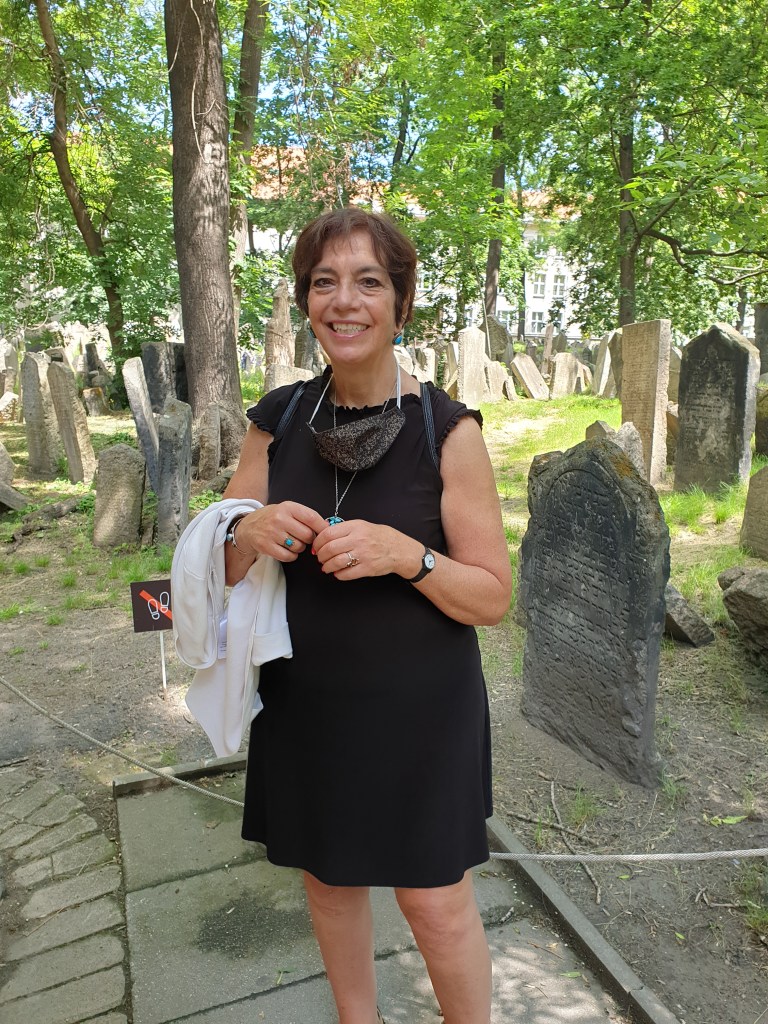
I emigrated from communist Czechoslovakia to the West in 1986, however, the communist regime fell in 1989, and we could travel back. We first came to Prague in 1992. and we took our English friends with us. We recommended them the Jewish cemetery and we were surprised that they were not very impressed by it. I understood when I went on my own and I had to walk slowly behind many tourists through a now full cemetery. It lost its magic.
Then, in the Covid lockdown in 2019, I got stuck in Prague for several months. I went to the Jewish cemetery and also to the Charles Bridge and they were both like any other places in Prague, normally full of tourists, empty. It was wonderful. But of course, tourism is good for the country, and I understand that it’s encouraged. It’s a problem. I’m a tourist very often too, so I shouldn’t be hypocritical about this.
My family has a grave at the 19th century New Jewish cemetery, close to the other large cemetery Olsany. It is an interesting, melancholy place. Full of graves that nobody ever visits because everybody who could have visited vanished in the Holocaust. Sad. Plates like This is in honour and memory of my mother and twenty other relatives who didn’t make the end of the war. There are many empty or half empty graves. Even on our family grave, there are sometimes just names of relatives who “Didn’t come back “as my family used to say. And sometimes nobody knew when exactly they died, so there is their name, date of birth and year of death.
It is pretty powerful.
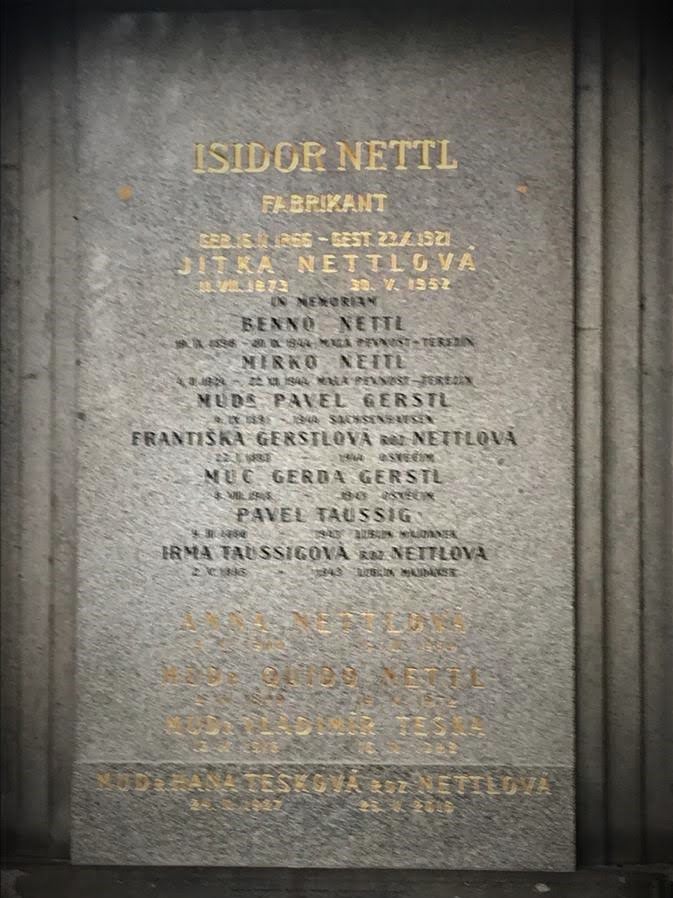
When I had the writing on our family tomb renovated, I changed the colour depending on whether they were just the names of the Holocaust victims or people who were actually buried there. Only the people with the inscriptions in gold are buried here. Nobody knows where the other ones ended. My mother’s name is the last so far.Her Brother Mirko Nettl and her Father Benno Nettl were killed by the Nazis.
This is a grave of close relatives whom I never met.
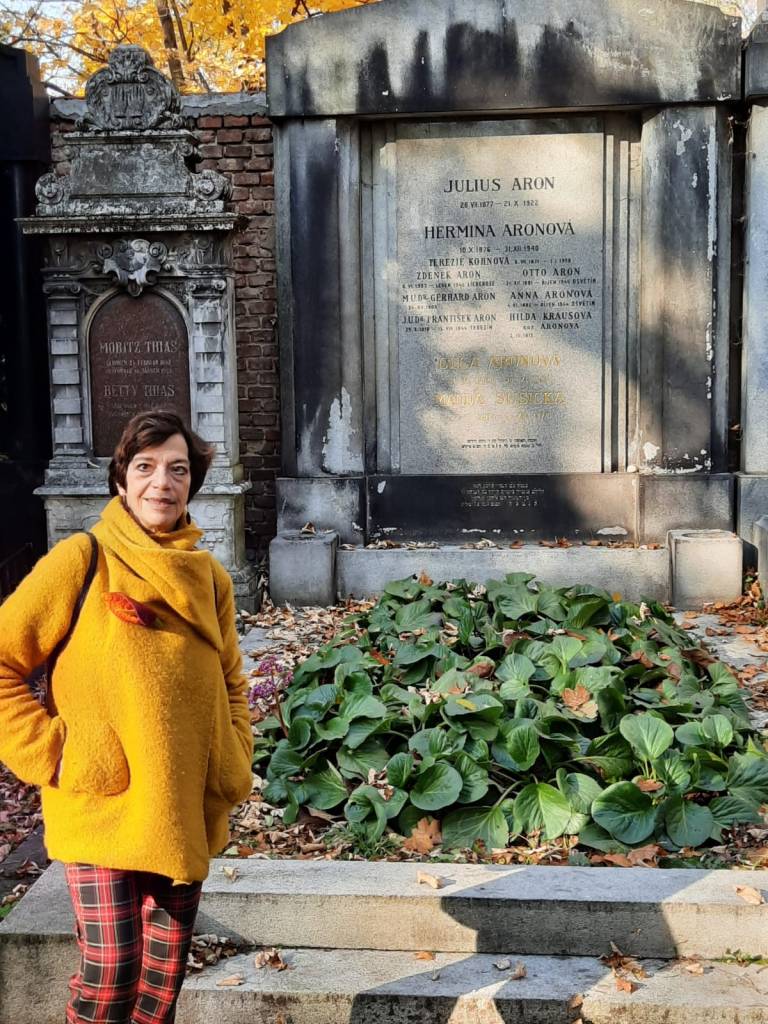
My mother always used to go to the cemetery at the All-Saints Day like most of Czech people. Of course, she didn’t celebrate All Saints Day. But she didn’t celebrate Jewish holidays either. A typical Prague Christmas celebrating, pork eating Jew, she didn’t really believe in anything. Once she was very cross when she went to the cemetery on Friday, and it was closed. “Mom, it’s Sabbath, and it is a Jewish cemetery, of course it is closed.”” What a nonsense,” she said.
In my family, mixed marriages were common even in the beginning of the 20th century. My Grandfather Benno had five siblings, only three of them had Jewish spouses. One of them married a German, one a Dutchwoman, and one a Czech Roman Catholic. Nobody cared. When my uncle Oscar came to ask for his future wife’s hand in marriage, his future father-in-law in Holland was talking about how important the Protestant religion was in the family.
My uncle Oscar got a bit insecure and said: “I don’t know whether you realise it, Sir, but I’m a Jew.”
“As long as you’re not a Catholic.” was the answer.
When my 89-year-old mother fell down the stairs in her weekend house and died, it was quite complicated to arrange a quick funeral at distance from England.
It was all sorted very efficiently by a man called Chaim Kočí, who arranged everything.

The funeral was quite exotic. Men in Jewish orthodox clothing carried the coffin and sang something in Aramaic, which we of course did not understand. Mr Kočí wanted my sons to say kaddish, but they were reluctant because they didn’t speak Hebrew, and they wouldn’t be able to read it.
Kočí showed me the English phonetic transcription and I read it. Nobody ever read it so beautifully, said Mr Koci.
Pity I am a woman.” I said. We both laughed.
One day when I die, I would like to be buried in this grave too. I feel a bit sorry for my sons who would have to arrange the transport of the urn with my ashes from England, but maybe Mr Kočí will help them. Maybe even with the kaddish…

 Eva Hnizdo